Sunday, 23 May 2010
Hairy Dragonflies at Fawsley Hall lakes
Hairy Dragonflies have been advancing west over the last few years and have now been recorded at Fawsley Hall, in the very west of Northamptonshire by Doug Goddard. This is the furthest west in the County and may actually represent eastwards expansion from Warwickshire.

The Hottest Weekend!


Well, what a change in temperature. Two weeks ago, temperatures were hovering around the 10-12 degree mark with a chilly north-westerly wind. This weekend has seen conditions approaching 30 degrees. Dragonflies like the hot sunshine, however at temps over 30degrees, they become less active.
On my way home from a business trip on Friday 21 May, I took a detour to the Nene at Lilford, Waddenhoe and Aldwincle looking for Scarce Chaser. This time last year, emergence was well underway, but this year I struggled and only found one. The cold weather must have delayed them somewhat. I expect now that emergence has begun, we will start to see them now and the Bank Holiday weekend may be a good time to look.
At Yardley Chase, Downy Emeralds were emerging in good numbers (see photos above) and Large Reds were very active mating and oviposting.
The River Nene at Thrapston yielded another Scarce Chaser along with ~100 Banded Demoiselle, 2 Hairys and many Common Blue and Red-eyed Damselflies.
Tuesday, 18 May 2010
Banded Demoiselle appearing on the Nene and Ise

I saw male and female Banded Demoiselle on the Nene near Rushden and the Ise near Weetabix on 17 and 18 May. The Ise also hade Large Red, Azure and Common Blue Damselflies.
Saturday, 15 May 2010
Downy Emeralds emerging


A turn in the weather to warm sunshine (16 degrees!) brought out a few emerging dragonflies at Yardley Chase this morning. After quite some hunting, we found a single male Downy Emerald emerging among several Four-spotted Chaser, including one unfortunate male being eaten from the tip of his abdomen by a spider, we rescued the Chaser, but it died through fluid loss. Two years as a larvae, 1 hour as an adult and you're breakfast for a hungry spider!! We found 6+ Hairy Dragonfly exuviae including a couple emerging. Also present were several Large Red, Azure and Blue-tailed Damselfly. The cold weather of recent weeks has certainly slowed emergence and adult numbers are still low. The coming weeks looks good though, so we may see a bit of a catch-up - I would expect Banded Demoiselle and Broad-bodied Chaser to be around by now. We did see a few BB Chaser larvae at the surface of the water, which is a good sign that they will emerge soon.
Monday, 10 May 2010
Four-spotted Chasers
Jeff Blincow reports the first Four-spotted Chaser of the year at Yardley Chase on Sunday 9 May.
Friday, 7 May 2010
Azure Damselflies at Wilson's Pits


Wilson's Pits always has a large number of Azure Damselflies in early May, declining as the season progresses to be replaced by Common Blue. Today there were only a few (10-20) and the odd Red-eyed Damselfly. I managed to capture these pictures of a female eating a small fly. The cool weather meant that they were quite docile, although the dull conditions made getting a decent picture quite hard. The top picture shows a Common Blue with striking pink colouration.
Wednesday, 5 May 2010
Common Blues emerging in good numbers


At Ditchford today, despite the overcast weather, I saw around 100 Common Blue Damselflies emerging and fluttering along the hedgerow. In amongst them were around 20 Red-eyed Damselfly. Both were in their typical juvenile colouration, with the Red-eyes looking especially drab (see above) showing none of the beautiful colour they will obtain in a few days. At the water margin, many more were emerging with plenty of exuviae. Four Hairy Dragonfly were emerging too, including the one above with a mal-formed wing. I think she is ~1 day old looking at her colouration compared with the others that had just emerged today.
Tuesday, 4 May 2010
Still a little slow out there!

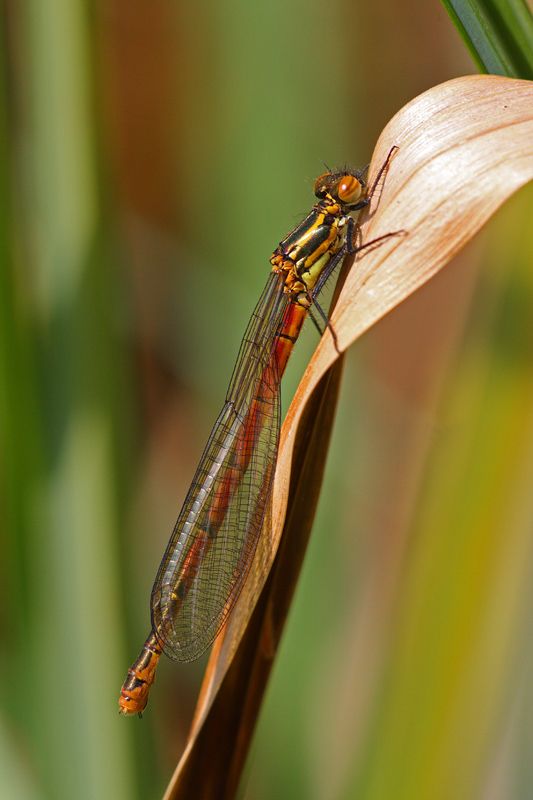
The north westerly winds are bring low temperatures and cold air that are appears to be slowing emergence somewhat. By 4 May, I would expect at least two more species to have begun emergence and Large Reds in much greater numbers. At Southfield Farm Marsh this lunchtime, despite nice sunshine I only saw two Large Red Damselflies including one recently emerged. I couldn't find any new exuviae, which implies a low level of emergence so far.
Monday, 3 May 2010
Hungry Blue-tailed Damselfly

Paul Mellows of Wellingborough sent in this photo of a rufescens form female Blue-tailed Damselfly consuming a crane fly. The Damselfly emerged from his pond on 27 April, making it the first record of this species in Northants. Its a great photo of our smallest dragonfly eating a meal that is at least as big as itself. Thanks for the record and excellent picture Paul!
Saturday, 1 May 2010
Large Red Damselfy & Hairy Dragonfly Emerging
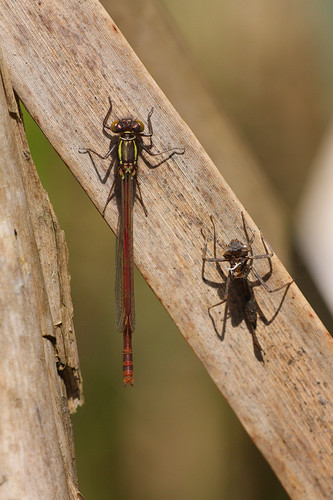


Despite poor weather forecasts for this weekend, it was bright and warm this morning so we ventred out and discovered more activity with ~60 Large Red Damselfly including many emerging and 2 Hairy Dragonfly emerging.
Tuesday, 27 April 2010
Hairy Dragonfly Emerging
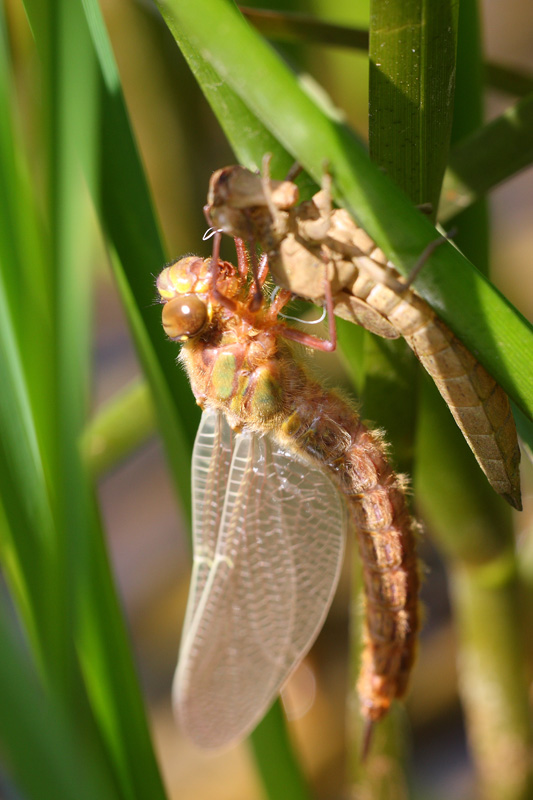
I went back to Southfield Farm Marsh again hoping to photograph some of the Large Reds. They were still playing hard to get and I didn't manage a single shot. However, I did find this emerging Hairy Dragonfly. Sorry about the poor picture - she was so low down among the reeds that this was the best I could get without ruining my work clothes (not great to go to a 1400hrs meeting covered in smelly pond mud!). I have seen Hairys here before, but never been able to prove breeding until now. I bumped into someone who told me that our friend John Showers, who was busy Hoverfly hunting, had seen an Azure Damselfly here earlier. I didn't see it though. Looking at the BDS Hot News page, this is the first Hairy seen this year and with the Azure we have the highest number of recorded species so far this year!
Monday, 26 April 2010
First Large Red Damselflies
Great weather on Saturday prompted a search at Yardley Chase , but nothing was seen except one Emperor larva basking at the water's surface. At lunchtime today, I walked to Southfields Farm Marsh SSSI near work and found 2 emerging Large Red Damselflies. Neither stayed to be photographed but flew straight into the trees surrounding the pond. The weather looks to be getting better during the week, so I will return and see if more are about and I can get that first photo.
Wednesday, 14 April 2010
Dragonflies Appearing in the South
After a harsh winter, the dragonflies are beginning to appear around 1-2 weeks later than in recent years, with Azure Damselfly and Large Red Damselfly seen in Essex and elsewhere. Northants is normally 2-3 weeks after the first sightings, which may mean we are slightly later than normal too. Good weather between now and end of April may change this, so keep an eye out!
Subscribe to:
Posts (Atom)