Sunday, 28 June 2015

Ruddy Darters

The coldest June for several years has kept dragonfly numbers to a low level as well as reducing time to go out and see then, never-the-less when the sun comes out there is still plenty of action to see.

At Wadenhoe, numbers of Scarce Chasers were good, with approximately 1 male per 10m of river bank and three mating pairs. Plenty of territorial clashes were happening due to the high male density. Banded Demoiselle numbers were lower than I expected form this time of year, with only around 200 present.

Tony Vials reported finding a female Scarce Chaser at Irthlingborough Pits last weekend, so I visited at lunchtime to try and fin more. Entering from the town side, the first section of the river showed 1 male, so I am hopeful that there are more and that colonisation has begun. I was very impressed by the new ditch on the left of the pathway. While watching a male Broad-bodied Chaser, I saw two Ruddy Darters take their first flights. The ditch showed 4 more male Chasers, a couple of Four-spotted Chasers and an Emperor. The ditch on the right is now fenced off, but is so overgrown with reedmace that it's value has declined. I worry that the same will happen to this new one as there are already signs of reedmace growth here.

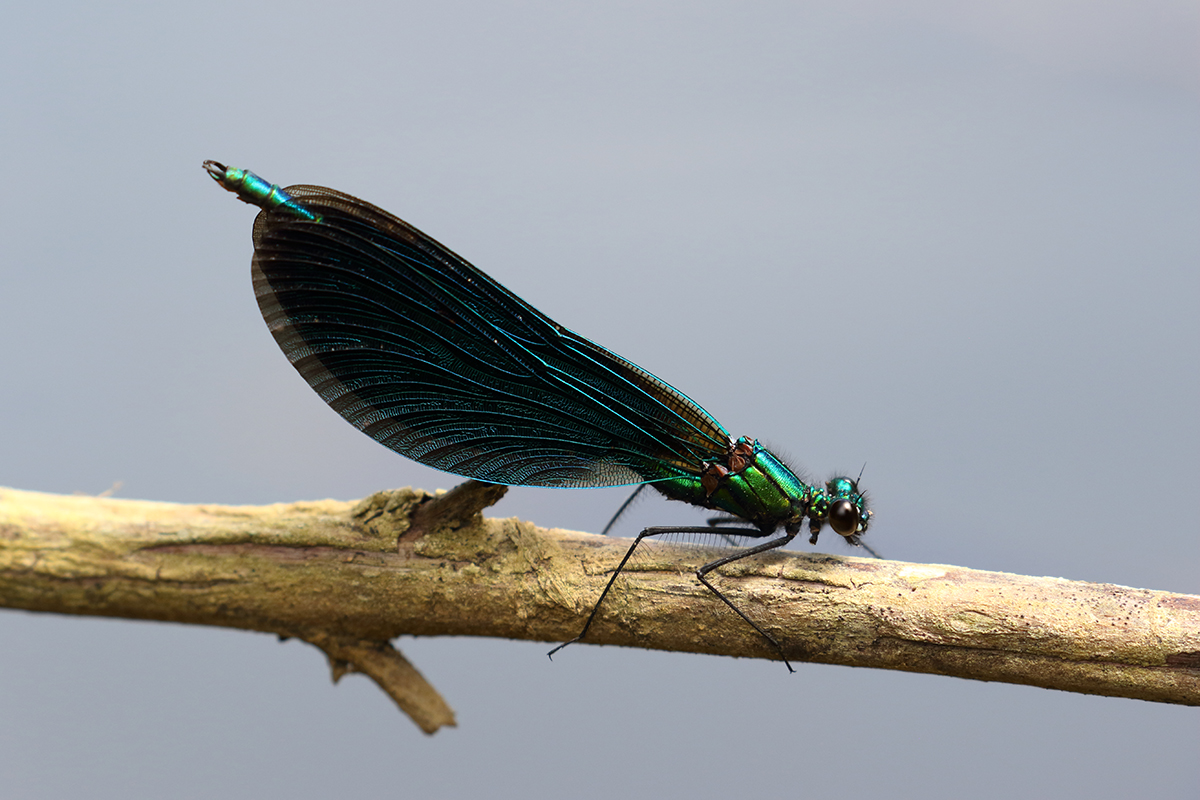
I took my customary trip to Greens Norton to see the Beautiful Demoiselles. About 20 adults were in attendance including a mating pair - my first sight of this, but they just would not settle for a photo. I also retrieved an exuvia.

Scarce Chasers, River Nene Wadenhoe

Beautiful Demoiselle, River Tove, Greens Norton

Thursday, 18 June 2015

Southern Hawkers and Common Darters appearing

My planned BDS field trip to Yardley Chase was a washout with constant drizzle all day. Five brave enthusiasts put the rain out of their minds and joined me for the day hoping to catch sight of a perched Downy Emerald. While no Emeralds were found, we did recover a few exuviae to the delight of Trish who needed one for her collection. While we braved the weather, so did a handful of emerging Four-spotted Chasers. One attracted much interest to the photographers (photo below) because we found it protecting itself under an Iris leaf in a very photogenic position. We found several more exuviae, including four Southern Hawkers, the first of the year.

Returning to the Chase, I found a few Downy Emeralds at territory but numbers appear to be well down compared with previous years, perhaps due to poor weather during their main emergence window.

White-legged Damselflies are now in good numbers on the Ise, with adults recorded at Burton Latimer Pocket Park, Harrowden Lane and south Wellingborough.

At Titchmarsh Nature Reserve, Scarce Chasers are  now at territory and Black-tailed Skimmers are appearing along with the usual Damselflies and Demoiselles. Emperors are also cropping up at territory after their relatively short maturation time.

Chris Emary reports the first Common Darter at Syresham.

Four-spotted Chaser emerging in rain


Male White-legged Damselfly, River Ise

Immature Male Southern Hawker

Blue-tailed Damselflies

Broad-bodied Chaser

Azure Damselflies (note the mites infesting the female)

Male Large Red Damselfly

Downy Emerald

Monday, 8 June 2015

Black-tailed Skimmers, thousands of Common Blues and Scarce Chasers

I took a break from the Sunday ironing and popped across the road to Stanwick Lakes. The ponds and pits around the Visitor Centre are great places for Black-tailed Skimmers, so I hoped to find a few emerging. Walking clockwise around the large gravel pit, close to the water, I must have disturbed over 2000 emergent Common Blue Damselflies. There were similar numbers around the other waters close to the centre. too I never tire of this experience and it always makes me wonder how many there actually are and how many these pits support in a year - 10,000+ maybe? Not forgetting the hundreds of Red-eyed Damselflies and Blue-tailed Damselflies! I only found one emergent Black-tailed Skimmer though - they are only just starting to emerge to I am sure there are more to come in the next few days.

In the afternoon, I took a walk along the Nene at Wadenhoe. Fewer than expected Banded Demoiselles were present along the river, with good numbers of Red-eyes on the lily pads. I counted around 15 Scarce Chaser, including one pair incop and around three emergent adults. All the males showed signs of the immature orange colouration through their blue pruinescence. I walked up to Achurch and through the rides to Lilford, hoping to find more immatures. Only one immature male was around along with a male Hairy Dragonfly.

Black-tailed Skimmer

Scarce Chaser

Scarce Chasers incop

Immature Male Scarce Chaser

Scarce Chaser

Scarce Chaser

Saturday, 6 June 2015

White-legged Damselflies and others

On the River Ise at Burton Latimer and Finedon, White-legged Damselflies are now present. All of the adults I saw were immature (no blue males) so must only have emerged in the last few days. In the immature stage, males and females look similar from a distance but up close the differences become apparent. Plenty of Banded Demoiselles around too.

I visited three sites in one day to try and catch a good range of species. Starting off at Yardley Chase, Downy Emeralds were showing in good numbers although none performed well enough to capture in flight shots except an ovipositing female. While watching her, I found a pair in cop which is something I have never seen before. Although the light wasn't in a perfect direction, I was able to get a shot that I am more than happy with especially as this is not commonly seen, mostly occurring high in the tree tops. There were plenty of Four-spotted Chasers around too and many ovipositing pairs. When the female oviposits, the male flies around her in a protection mode to fight off other males. This gives the best opportunities for in flight shots. Unfortunately, this was when the sun went behind a cloud which caused my camera's ISO to shoot up hence increasing image noise. A pair of Broad-bodied Chasers made an appearance and ovipositing ensued. I still have a few spaces on my field trip here for 13 June so if you would like to come along, please contact me. This is a permit only site so there is no access to the public (the site is also locked!). 

At Maxey Pits, I saw fewer Variable Damselflies than usual, mostly males and 1 female, with one pair fleetingly seen in tandem. I visit this site about once per year around this time, so I haven't hit the end of their season and hope this is just a blip and doesn't indicate the start of a decline in the species. Plenty of Common Blues, Blue-tails and Azures.

My final stop was at Wadenhoe looking for Scarce Chasers. None were in evidence, but by  now it was 1600hrs and a bit breezy so they may have gone to roost for the evening. What did surprise me was the number of Red Kites around. I often see 4-5 here, but today there were around 30 (I did try to count) and I wondered whether they were breeding and the young had just fledged. They were clearly visible over the manor house from the Mill car park.

Chris Emary reports Beautiful Demoiselles at their usual sites on the River Tove near Towcester at Greens Norton.

Female White-legged Damselfly


Male White-legged Damselfly

Four-spotted Chaser

Downy Emeralds in-cop

Tandem Large Red Damselflies

Rufescens form female Blue-tailed Damselfly

Male Variable Damselfly

Sunday, 24 May 2015

Four-spotted Chaser emergence

There was a strong synchronised emergence of Four-spotted Chasers on 22 May, and I counted 35 at all stages from just leaving the water to full wings open. I captured a full sequence, which I have done before, but this is the first time I managed to get a shot of the adult extracting itself from the exuvia.


Downy Emerald emergence timelapse

I've been keen to try out the intervalometer on my new Canon 7D mark 2 on an emerging dragonfly, so when I located this Downy Emerald I set the camera up to shoot 1 picture every 10 seconds. Video works at around 25 frames a second, so for 1 second of video I needed to record about 3 mins of actual time. In total, I took about 1000 images of the full emergence and then cut the process down into the two key stages. There was quite a breeze so the reed moved a little between frames, hence why it looks jerky. I learnt a lot during this time, and in the subsequent processing and my next attempt will be much better.


Here's the adult just before its maiden flight.


Wednesday, 20 May 2015

Scarce Chasers emerging on the Nene

I stopped off at Lilford this lunchtime and quickly located 2 emerging Scarce Chasers and 2 exuviae. It was windy, but that didn't cause any problems for the adults. Also, one Hairy Dragonfly exuvia and several emerging Banded Demoiselles. Moving on to the Nene at Titchmarsh Nature Reserve, there were several Demoiselles around and good numbers of Azure Damselflies around the Nene. One emergent male Scarce Chaser took it's first flight and landed conveniently by the small footbridge.

Female Scarce Chaser (Lilford)

Male Scarce Chaser (Titchmarsh Nature Reserve)  

Sunday, 17 May 2015

Four-spotted Chasers

I found my first Four-spotted Chaser exuvia and a single emerging adult at Ditchford on 15th. Several Hairys were emerging too. I haven't yet seen a Hairy at territory, so it can't be far off.

I don't often go round to the second lake as it doesn't have quite as many species as the meadow lake, however I am glad I did as I disturbed 100+ emerging Common Blues. The meadow lake has been slow to yield Common Blues this year, and I have only seen a handful at a time, so it was great to see so many coming out. Also, two Hairy exuvia. Lots of Red-eyes too, including some taking up territory on floating vegetation.

I took a walk around Wilson's Pits on 17th. I am concerned about the future of this site now that the Rushden Lakes development has been given the go-ahead, but know that the Wildlife Trust are consulting on the project. I have even offered some photos for interpretation boards. Work has already started and many hedges have been removed from the Skew bridge side. At least it will stop the fly tippers. Anyway, Wilson's Pits is always good for Azure Damselflies at this time in May. Numbers have declined here in the last 10 years, probably because some of the shallow waters have been lost to succession. On my visit, there were around 50 Azures, several Red-eyes, Common Blues, one Hairy and one female Broad-bodied Chaser.  

Female Hairy Dragonfly

Teneral Common Blue Damselfly

Four-spotted Chaser

Immature Male Azure Damselfly

Female Broad-bodied Chaser

Thursday, 14 May 2015

River Nene at Wadenhoe

I took a walk along the Nene at Wadenhoe, one of my favourite sites. It's a little early for Scarce Chasers - perhaps nearer 18th-23rd May, but there were around 30 Banded Demoiselles in attendance and a few Large Red Damselflies. Surprisingly, I came across a recently emerged male Broad-bodied Chaser. I don't know of any suitable shallow ponds near here so am unsure where it came from.

As BBCs are now emerging, I stopped off at Twywell on the way to work this morning and visited the Whitestones Ponds. The small Chaser pond (as I call it) is completely dried up, so I am not expecting anything to emerge from it as the compacted mud must make it impossible for larva to crawl out. The middle pond still has a good water level, hopefully enough to support the larvae. I couldn't find any exuviae, but than that doesn't mean too much as I don't exactly have a great track record of finding BBC exuvia.

Male Banded Demoiselle

Male Broad-bodied Chaser

Female Banded Demoiselle

Female Large Red Damselfly

Sunday, 10 May 2015

Azure Damselflies appearing

During a very brief visit to Ditchford on Sunday lunchtime, I was surprised at how many Red-eyed Damselflies were emerging compared to other species. In amongst ~30 Red-eyes were only one of two Common Blues and one female Azure Damselfly.  Normally good numbers of Common Blues emerge alongside the Red-eyes. Perhaps we are in for a good Red-eye year? A couple for Blue-tails were resting in the reeds, but from their colouration I estimated they were a day or so old. No Hairys were emerging (that I could find at least).


Female Azure Damselfly


Blue-tailed Damselfly


Red-eyed Damselfly Exuvia


Make Red-eyed Damselfly

Tuesday, 5 May 2015

New look for my blog

I have updated the look of my blog to use Google's latest tech. This allows my pictures to be shown larger than before. There might be a few teething issues and I may make a few adjustments in the coming days until I am happy with the new look, so apologies in advance. Thanks - Mark

Monday, 4 May 2015

Bank Holiday Activity

After completing the morning's chores, I managed an hour at Ditchford. This was time to find a number of emerging Red-eyed Damselflies, Blue-tailed Damselflies and a single Common Blue Damselfly. There were also a handful of emerging Hairy Dragonflies too.

At about the same time, John Windust found Banded Demoiselles on the River Nene at Higham Ferrers.

This adds 4 new species to the County in the same day.


Banded Demoiselle (photo John Windust)


Red-eyed Damselfly


Blue-tailed Damselfly


Red-eyed Damselfly