Monday, 25 July 2016

A visit to Lyveden New Bield

About 8 years ago, I conducted a survey of the dragonflies at Lyveden New Bield for English Heritage. They wanted to know what species were present and how to manage the ornamental ponds. Since then, they have dredged the ponds to remove silt. Judy & Terry Wood are frequent visitors and have recorded Scarce Chasers there. As I had some spare time on Saturday, I thought I'd make a return visit to see for myself what the current status is. I was pleased to record 12 species, which puts it near the top of the best sites in the County - there were 25 Emperors, including 8 ovipositing, Brown Hawkers, Common & Ruddy Darters, Red-eyed Damselflies, Banded Demoiselles, Common Blue and Azure Damselflies, Blue-tailed Damselflies, Emerald Damselflies, Four-spotted Chasers. The most significant of all was a very strong population of Small Red-eyed Damselflies, including many ovipositing pairs. There were also many recently fledged Swallows flying around the fields. Well worth a visit.

Tony Vials reports the usual species at Summer Leys, including emerging Migrant Hawkers on Saturday. I found 3 exuviae at Ditchford last Wednesday, but no adults.

I popped into Barnwell Country Park on Sunday, on the way home from Ounde Marina (they are opposite each other after all!). The lake on the left of the car park was buzzing with Emperors, Four-spots, and Black-tailed Skimmers. Rudy & Common Darters were also present along with the usual Damsellfies including Small Red-eyes. The river sections hosted many Banded Demoiselles. One Common Blue had very strange abdominal markings that I thought at first were damage, but when I photographed it from above appeared to be symmetrical. This species is known for aberrant markings, but this is the first one I have seen.

Female Brown Hawker, Ditchford

Ovipositing Brown Hawker, Ditchford

Ovipositing Brown Hawker, Ditchford

Four-spotted Chaser, Lyveden New Bield

Ovipositing Emperor, Lyveden New Bield

Ovipositing Small Red-eyed Damselflies, Lyveden New Bield

Ovipositing Small Red-eyed Damselflies, Lyveden New Bield

Mating pair of Small Red-eyed Damselflies, Lyveden New Bield

Mating pair of Small Red-eyed Damselflies with on-lookers, Lyveden New Bield

Ruddy Darter, Barnwell CP


Common Blue Damselfly with unusual markings, Barnswell CP

Black-tailed Skimmer, Barnwell CP

Tuesday, 19 July 2016

Quiet Period

I always consider mid July to mid August as the quiet period in the dragonfly season. Not because there are fewer species around, but because those species that are present are seen in smaller numbers. Common Blues are significantly down, as are Four-spotted Chasers. Even Banded Demoiselles are less numerous along gthe Nene. The main hawkers present - Emperor and Brown are extremely territorial so are only seen in ones or may be twos. Things do pick up when Common Darters become common and Migrant Hawkers appear in their hundreds in late August.

Sywell Reservoir is showing a good variety of the usual species at the moment, as are Ditchford, Titchmarsh and Summer Leys. Mark Piper reports good numbers of Emerald Damselflies and Ruddy Darters are Ravensthorpe ponds, and Darryl Sutcliffe has found more Beautiful Demoiselles on the lower stretches of the Brampton Valley Way. 

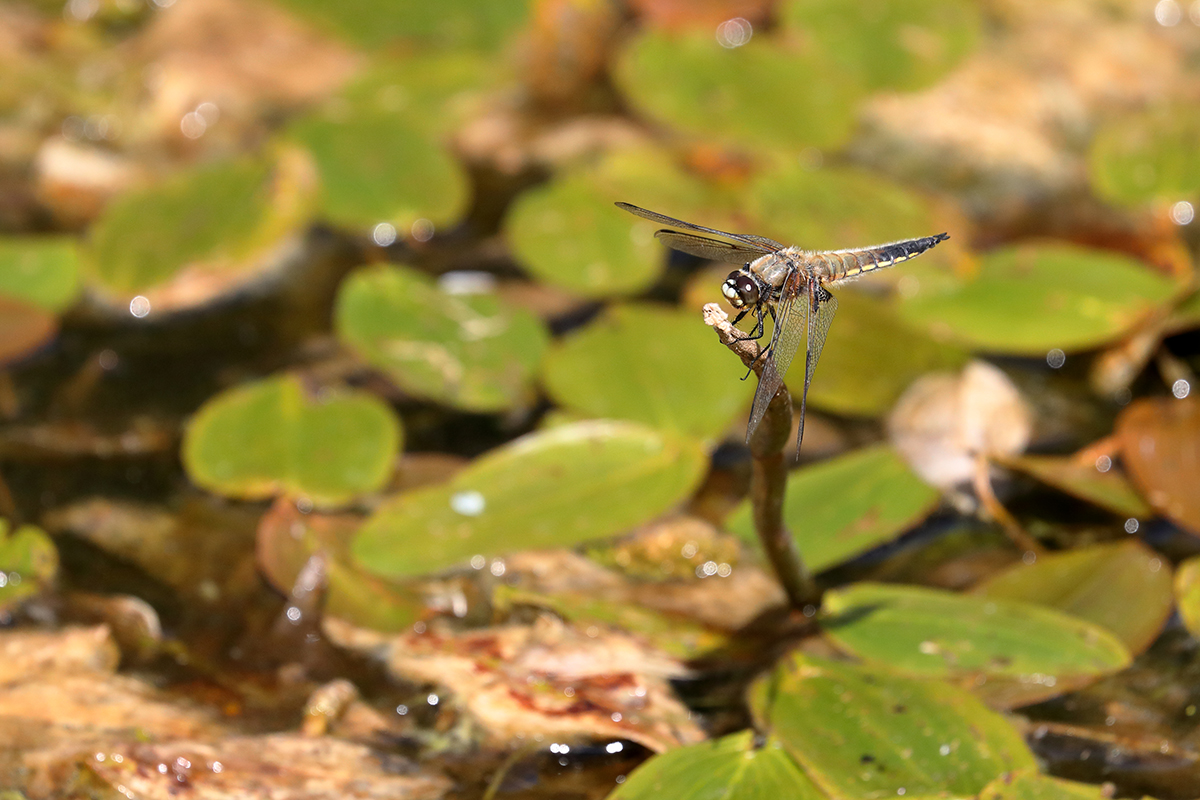
Four-spotted Chaser

Common Blue Damselflies (female of the blue form)

Ovipositing Emperor

Ruddy Darter

Common Darter

Wednesday, 13 July 2016

Beautiful Demoiselles on the Brampton Valley Way

The upper reaches of the Brampton Valley Way are fast flowing with gravelly bottoms, which is ideal habitat for the Beautiful Demoiselle. The bridge over the river at Hanging Houghton is a good spot to see them, as is any fairly open section of the river. Many areas can be shaded or overgrown, so you may have to look hard to find them. In some areas they co-exist with Banded Demoiselles, especially where the water pools. Today, I found several of both species along with Brown Hawker and Blue-tailed Damselfly. The Bandeds did not tolerate the Beautifuls at all, and they were far more aggressive with them than with fellow Bandeds.


Monday, 11 July 2016

Decline of the spring species

Early July heralds the transition between the spring species, typified by Hairy Dragonfly, Four-spotted Chaser, Downy Emerald and the Large Red Damselfly, and the advance of the summer/autumn species. Numbers of Four-spots have declined rapidly, but can still be found as can Large Red Damselflies. However, no Hairys have been seen for a while now. and this is the first year I can recall that I haven't seen any Downy Emeralds in flight at Yardley Chase, which is mostly down to the poor weather. 

To compensate, Emperors and Brown Hawkers are now seen in good numbers, and the Darters are starting to appear, mostly Ruddy Darters at the moment, along with Emerald Damselflies


Female Emerald Damselfly

Female Emerald Damselfly

Male Ruddy Darter

Male Ruddy Darter

Emperor
Blue-tailed Damselfly attempting to mate with a Large Red

Male Ruddy Darter


Wednesday, 6 July 2016

Hawkers and Darters

I saw my first Brown Hawker on Sunday, along the River Nene at Ringstead. This is about two weeks later than usual for me, although they probably emerged on schedule. The river was full of Scarce Chasers, and with Darryl Sutcliffe's sightings along the Nene at Thorpe Waterville, must make several hundred seen over this stretch of the river - quite amazing for early July when this species are on the decline. At Wadenoe today, there were good numbers too including a couple of mating pairs, Brown Hawkers and Emperors including an ovipositing female.

During a lunchtime walk along the River Ise at Burton Latimer, I saw my first Common Darter, which just leaves Emerald Damselflies and Migrant Hawkers to go!

Mating Scarce Chasers at Wadenhoe

Monday, 27 June 2016

Things are still quiet out there in dragonfly land, although they are still going about their business in the short periods of sunny weather we are seeing. I had a bit if a Scarce Chaser hunt on Sunday, after a visit to Wadenhoe last Friday where I found 40+ Scarce Chasers, many males with mating scars so they have been active despite the weather. Dragonflies have survived 100s' of million years so a period of poor weather shouldn't affect them too much. At Stanwick Lakes, I found 20 Scarce Chasers on the navigable section of the Nene at the back of the reserve. Emperors are appearing at territory now, with adults seen at Wadenhoe and Stanwick. I am hopeful that the Nene at Summer Leys will at some point host these Chasers, but on Sunday I could find none in amoung the thousands of Banded Demoiselle, Common Blue Damselflies, Red-eyes and a few Emperors. I enjoyed watching an ovipositing pair of Red-eyes, where they both completely submerged while the female laid her eggs safely inside the floating plants. The eventually emerged and flew off a few minutes later.

Mark Piper reports the first Ruddy Darter at Stanford Reservoir on 25th, and Doug Goddard spotted the first Southern Hawker at Salcey Forest on 26th.

Today I returned to the Greenway at Irthlingborough hoping to find more Variable Damselflies. I found none, but did spot a male Small Red-eyed Damselfly. I found a good population here last year.


Old female Scarce Chaser

Old female Scarce Chaser


Black-tailed Skimmer

Four-spotted Chaser


Tuesday, 21 June 2016

Variable Damselfly at Irthlingborough Lakes

Dragonflies have been very thin on the ground recently, due in no small part to the poor weather. The only species reported in the last week is the Black-tailed Skimmer. I took a walk around the pits surrounding the Visitor Center at Stanwick Lakes on Sunday hoping to find some Skimmers emerging. I did find an exuvia on the boating lake and several adults around the gravel area by the Boating Lake, including a pair in-cop. None were happy to be photographed though. Around these lakes, I estimated there were in excess of 2000 Common Blue Damselflies, with many hundreds emerging - the reeds are littered with exuviae. There were also hundreds of Blue-tailed Damselflies with many pairs in-cop. 

The White-legged Damselflies on the Ise at Harrowden and by Weetabix are holding out well, with many blue males now present. The Black-tailed Skimmer I saw last week is still there, in the same spot too!

At the Greenway, Irthlingborough Lakes today, despite 21 degrees temperature, the lack of sunshine kept activity low. One Black-tailed Skimmer was seen on the path, but around the left-hand ditch activity was low. However, as the title of this post shows I was stunned to find a male Variable Damselfly, the first sighting of this species in Northants this year. This species is enigmatic and its habitat requirements are not well understood. There may be a small colony in one of the ditches here and I will be surveying more in the next few days in the hope of finding them. If any blog readers visit the site, please check every single Blue damselfly just in case!! I will inform the Wildlife Trust who manage this site and hope to get permission to search in off-limits areas. Please also keep an eye out in surrounding areas.

Blue-tailed Damselflies mating

Blue-tailed Damselflies mating

Male White-legged Damselfly, River Ise public footpath by Weetabix

Variable Damselfly, Greenway at Irthlingborough Lakes 

Sunday, 12 June 2016

Scarce Chasers still emerging

Terry & Judy Wood visited Lyveden New Bield for the first time since 2014, and recorded a Scarce Chaser on territory. Back in 2014, they also recorded this species and it is possible they are breeding in the linear ponds there. This may also be the source of the Fermyn Woods individual seen by Roland Bogush. They also saw plenty of Four-spotted Chasers, 3 Hairys (a first for this site), Large Red, Blue-tailed, Red-eyed and over 200 Azure Damselflies. This sounds like a great site and well worth a visit, oh and you also get to see the beautiful unfinished mansion as well. 

David Warner reports seeing 6 Beautiful Demoiselle at Harlestone Heath, by the railway line. There is a fast flowing stream here accessible via the golf course. This colony have now been present for a good number of years and appear to be well established.

At Wadenhoe, I found 10 emerging Scarce Chasers, which is quite late for them, with only 1 male on territory. Hundreds of Banded Demoiselle were also present along with a single Hairy.

We may soon be buying a small boat to pootle along the Nene and are trying to pick up ideas on the best places to visit, so we took a walk along the navigable section of the Nene at Stanwick Lakes between the lock and the footbridge. There were thousands of Banded Demoiselle present in the marginal vegetation and at territory over the water. When the sun came out (through thunder stormy clouds), the activity levels increased dramatically. I scanned the margins hoping for a Scarce Chaser, but could find none. One of my planned uses for the boat is to count all male Chasers from Oundle, where we hope to keep the boat, to Stanwick while my wife drives!

Common Blue with a bent abdomen

Mating Blue-tailed Damselflies, with a female of the rufescens obsoleta colour form

Make Scarce Chaser at Wadenhoe

Recently emerged Scarce Chaser, Wadenhoe

Recently emerged Scarce Chaser, Wadenhoe

Recently emerged Scarce Chaser, Wadenhoe

Recently emerged Scarce Chaser, Wadenhoe

Male Banded Demoiselle, Wadenhoe

Tuesday, 7 June 2016

A walk along the Ise

With my car in the garage for new brake disks, I took the opportunity to walk on the public footpath alongside the Weetabix factory up the River Ise towards the A14 flyover.. Fortunately, the Council have trimmed back the grass and nettles so I didn't get stung too much. I disturbed a resident Little Egret just before I got my first sighting of a couple of White-legged Damselflies, in all I saw about 20 which all looked recently emerged. None were showing signs of blueness so it was hard to separate males from females. Numbers of Banded Demoiselles were low and adults were quite hard to find, as were Large Red Damselflies. I met a work colleague, Brendan who told me he'd seen a large blue dragonfly further up in Southfields Farm Marsh. Hoping for a Scarce Chaser I hurried along, and found a beautiful semi-mature male Broad-bodied Chaser at territory over a muddy pond. While not quite as exciting as a Scarce Chaser on the Ise (I am still expecting this within the next few years), it's always great to find a new BbC site.

On the walk back, I spotted an unusual dragonfly flying around the recently mown path, expecting a Hairy, I was surprised to find it was a Black-tailed Skimmer. I recall from visits about 7-8 years ago, a thriving colony in the wildlife ponds at Wicksteed park, so I presume it came from there which is only a short distance away. I shall have to return there to re-survey this year. This is one of the things I find exciting - dragonflies are predictable in their habitats, but occasionally throw up a wobbly by appearing in totally unsuitable sites, particularly during their maturation phase. The sightings of Scarce Chaser at Fermyn Woods and more recently at Fineshade Wood (by Barrie Gilpin) are cases in point.


Make Broad-bodied Chaser

White-legged Damselfly

Bottom end of a female Banded Demoiselle

Front end of a female Banded Demoiselle

Sunday, 5 June 2016

A quiet week

Not much to report as this last week has been overcast and cold with little opportunity for seeing any dragonfly action. I did find 12 Emperor exuviae today and was really frustrated that despite getting out really early, I didn't find a pre-flight adult. At Castle Ashby Gardens this afternoon, there were many Azures, Large Reds, Blue-tailed Damselflies and a few Four-spotted Chasers around the ponds.

Barrie Gilpin reports finding a Scarce Chaser at Fineshades Woods. With Roland's record of an immature make at Fermyn Woods, this species appears to be very mobile this year despite the poor weather.

Emperor exuvia