![]() |
| Female |
Monday, 23 June 2014
Beautiful Demoiselles
I took my regular visit to the River Tove on Sunday, before the British Grand Prix closes the area down!. There were around 30 Beautiful Demoiselle flitting around the river at Greens Norton, which is my favourite site for them. This species is doing well this year, with records coming in from Darryl Sutcliffe at several sites along the Brampton Valley Way; from Alison Lowe at Sulby (tantalisingly close to the River Welland) and from various streams near the Nene at Stortons Pits. The sightings near the Welland at Husbands Bosworth (which is in Leics) are very promising for expansion into Leicestershire, and I await feedback from Ian Merrill the Leics recorder to see if they have turned up there.
Thursday, 19 June 2014
Scarce Chasers and an ovipositing Emperor
I stopped off at Wadenhoe to catch some Scarce Chasers, and there were plenty of males around, and one old looking female. Hundreds of Banded Demoiselles were in the marginal reeds. While photographing a male Chaser, this female Emperor conveniently landed just in front of me, and began to oviposit into a lily stem. I thought the reflection was great and really helped make the picture.
Friday, 13 June 2014
More Hawkers and the first Darter
Emperors are now a common sight across our ponds and lakes, with adults seen at Tywell, Ditchford and Yardley Chase. At Ditchford, I found loads of Emperor Exuviae and one recently emerged female who had died after completing emergence. I thought at first she was waiting to fly, but on closer inspection I could see fluid dripping from her abdomen. After nudging a few times, I realised she was dead. There were several males hawking across their territories, and I managed a few decent in flight shots. A handful of Brown Hawker exuviae were also present.
At Ditchford there were many blue form female Common Blue Damselflies in amoung the thousands of males. This colour form is rare in the early spring, but seems to become more common as the season progresses. The usual form is the pale yellow-brown. Common Blues have two phases of emergence, in early spring for larvae that are two years old and then mid summer for last year's larvae and I have often wondered if this contributes to the different numbers? Here is a sot I have been trying to get for a while now, showing both male and blue form female mating.
At Yardley Chase on Tuesday I found many Southern Hawker exuviae but no adults. Downy Emeralds were showing well.
The Whitestones Ponds at Twywell were buzzing with Broad-bodied Chasers, with over 12 adults across the three ponds. A couple of females appeared, were promptly mated and began ovipositing. They always seem to do it in photographically poor spots though!
John Windust reports the first Ruddy Darter at Summer Leys on 12 June.
At Ditchford there were many blue form female Common Blue Damselflies in amoung the thousands of males. This colour form is rare in the early spring, but seems to become more common as the season progresses. The usual form is the pale yellow-brown. Common Blues have two phases of emergence, in early spring for larvae that are two years old and then mid summer for last year's larvae and I have often wondered if this contributes to the different numbers? Here is a sot I have been trying to get for a while now, showing both male and blue form female mating.
At Yardley Chase on Tuesday I found many Southern Hawker exuviae but no adults. Downy Emeralds were showing well.
The Whitestones Ponds at Twywell were buzzing with Broad-bodied Chasers, with over 12 adults across the three ponds. A couple of females appeared, were promptly mated and began ovipositing. They always seem to do it in photographically poor spots though!
John Windust reports the first Ruddy Darter at Summer Leys on 12 June.
Sunday, 8 June 2014
Downy Emeralds and Black-tailed Skimmers
I took a walk around Stanwick Lakes on Sunday morning as the sun was gloriously bright and warm. I was amazed at the number of Common Blue Damselflies emerging and the total I saw must have exceed 3000. This was quite a sight! I was searching for Black-tailed Skimmers and disturbed about 15 taking their maiden flights. The adults weren't that helpful and didn't stay around too long, except two individuals who allowed me a close approach. Also, many Red-eyed Damselflies, Blue-tailed Damselflies and Four-spotted Chasers. On the river, hundreds of Banded Demoiselles were flitting about, but unfortunately, I didn't see any Scarce Chasers.
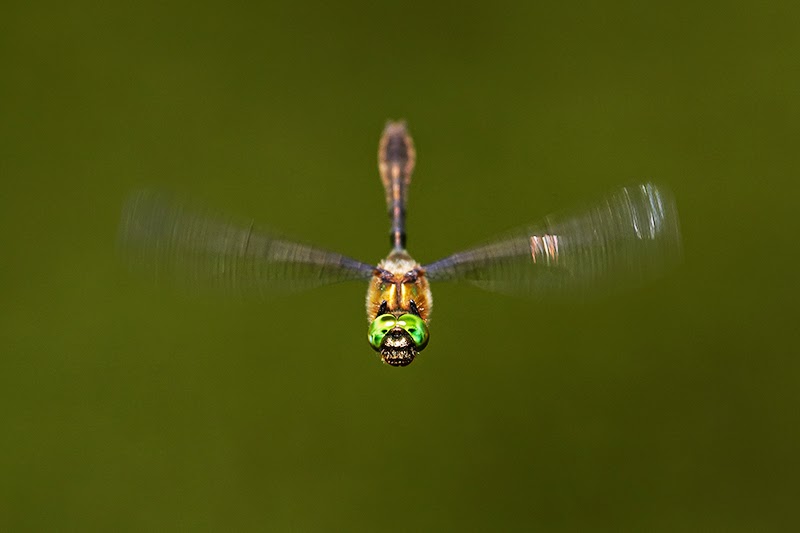
At Yardley Chase, I managed my first in flight shots of the year, of Downy Emeralds.
Monday, 2 June 2014
Variable Damselflies, Banded Demoiselles and Scarce Chasers
I made my regular trip to Maxey Pits on Sunday, to see the Variable Damselflies. There were over 30 present with many pairs ovipositing. Unfortunately, the sun is at the wrong angle for decent photographs in the morning, but I managed a decent record shot. For photography, this site is best visited in the afternoon. Also present were many Azures, Blue-tailed Damselflies and Four-spotted Chasers including two ovipositing. A couple of Hairys flew around too.
I moved on to Wadenhoe, where I was astonished by the number of Banded Demoiselles. There must have been 1000+, in fact so many that they were sharing territories. Scarce Chasers were, as their name suggests scarce, with only 5 in evidence, including two that looked like they'd emerged that morning. Apart from a few Red-eyed Damselflies on the lily pads, there were no other species in evidence, or was I overwhelmed by the number of Demoiselles?
![]() |
| Male Variable Damselfly |
![]() |
| Male Banded Demoiselle |
![]() |
| Immature Male Scarce Chaser |
![]() |
| Male Scarce Chaser |
Saturday, 31 May 2014
Common Club-tails on the Thames at Goring
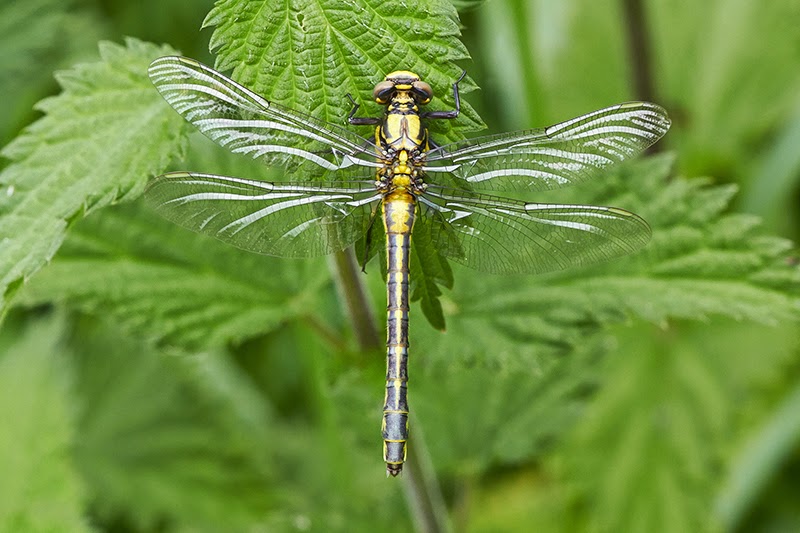
I've been meaning to visit the Thames at Goring for a number of years, but have been unable to make the time. This year, the Mother-in-law was staying with her sister at Chinnor, so I volunteered to collect her, oh and pop into Goring on the way - well, with a slight detour anyway. Once at the site by the railway bridge, I promptly found my first exuvia. I spent about 2.5 hours looking for adults without any luck and decided to go back to bridge for lunch. I bumped into three others also searching, and while chatting one of them spotted this teneral at exactly the spot I started my search. He must have emerged while I was off searching! How disappointing. Well, I did get to see one - my first, so it wasn't a waste of time. And, I located three more exuviae too. There is a record of this species from the River Nene near Wansford from 1951, and I have been keen to understand whether the Nene ever held a breeding colony - if it can support Scarce Chaser and White-legged Damselflies, why not Club-tails? I have searched the Nene several times, without success, but this is an elusive species where hundreds can emerge and only a few adults ever seen, so it may still be here undiscovered.
Thursday, 22 May 2014
River Species
I managed to track down 40+ White-legged Damselflies on the River Ise near Finedon the other day and at last found a few Scarce Chasers at Wadenhoe, just before they dispersed during their maturation period. At Wadenhoe, there also were hundreds of Banded Demoiselles, a female Hairy Dragonfly and an emerging male Hairy too. I am always amazed that Hairys breed in this river. After capturing a few shots of an immature Chaser, I concentrated on the territorial behaviour of the Demoiselles and managed some decent shots of males fighting over the best territories.
![]() |
| Close-up of the legs of a teneral White-legged Damselfly |
![]() |
| Male White-legged Damselfly |
![]() |
| Immature Scarce Chaser |
![]() |
| Battling Banded Demoiselles 1 |
![]() |
| Battling male Banded Demoiselles 2 |
Sunday, 18 May 2014
A big week for new species
After about 10 days of cool, rainy and windy weather, a break with some sunshine an warmth had a big impact, with 6 new species emerging between 14 May and 17 May.
On 14 May, Chris Emary reported seeing this year's first Beautiful Demoiselle on the River Tove at Greens Norton. On the same day, Freddie Ingall and Alison Lowe found 4 immature Scarce Chasers on the River Nene at Titchmarsh Nature Reserve.
On 15 May, Chris saw a pair of Broad-bodied Chasers at Greens Norton.
On 16 May Chris found White-legged Damselflies on the River Nene at Upron Mill near Rothersthorpe.
I visited a few sites over the weekend and found 20+ emerging Four-spotted Chasers and 30+ emerging Downy Emeralds at their only site in the County. A visit to the Nene at Lilford failed to find any Scarce Chasers, although I popped to Twywell and found 1 male Broad-bodied Chaser. I have been searching the Whitestones Ponds for the last three weeks of so and failed to find any emerging Broad-bodied Chasers, so I am at a loss to know how I missed this one! This is one species I vowed learn more about this year, but I remain in the dark about where it emerges.
On 14 May, Chris Emary reported seeing this year's first Beautiful Demoiselle on the River Tove at Greens Norton. On the same day, Freddie Ingall and Alison Lowe found 4 immature Scarce Chasers on the River Nene at Titchmarsh Nature Reserve.
On 15 May, Chris saw a pair of Broad-bodied Chasers at Greens Norton.
On 16 May Chris found White-legged Damselflies on the River Nene at Upron Mill near Rothersthorpe.
I visited a few sites over the weekend and found 20+ emerging Four-spotted Chasers and 30+ emerging Downy Emeralds at their only site in the County. A visit to the Nene at Lilford failed to find any Scarce Chasers, although I popped to Twywell and found 1 male Broad-bodied Chaser. I have been searching the Whitestones Ponds for the last three weeks of so and failed to find any emerging Broad-bodied Chasers, so I am at a loss to know how I missed this one! This is one species I vowed learn more about this year, but I remain in the dark about where it emerges.
![]() |
| Downy Emerald emerging |
![]() |
| Downy Emerald emerging |
![]() |
| Four-spotted Chaser |
Wednesday, 7 May 2014
Recent sightings
While the weather takes a damp and cool break - hopefully not for long - here are a few photos of what's around.
Twywell Hills & Dales is beginning to show, although I haven't managed to find any emerging Broad-bodied Chasers yet. I found a pair of Large Reds in tandem, many around the hedges and a single Azure Damselfly. Also, one Hairy Dragonfly flying around the meadow.
Tony Vials reports seeing a Large Red at Summer Leys on Saturday.
On Sunday, we took a walk around Thrapston Lake where I saw ~50 Banded Demoiselle on the Nene. Also, a handful or Red-eyes and a single Hairy Dragonfly exuiva on the lake.
Twywell Hills & Dales is beginning to show, although I haven't managed to find any emerging Broad-bodied Chasers yet. I found a pair of Large Reds in tandem, many around the hedges and a single Azure Damselfly. Also, one Hairy Dragonfly flying around the meadow.
Tony Vials reports seeing a Large Red at Summer Leys on Saturday.
On Sunday, we took a walk around Thrapston Lake where I saw ~50 Banded Demoiselle on the Nene. Also, a handful or Red-eyes and a single Hairy Dragonfly exuiva on the lake.
![]() |
| Male Banded Demoiselle |
![]() |
| Female Banded Demoiselle |
![]() |
| Male Large Red Damselfly eating lunch |
![]() |
| Tandem pair of Large Reds |
![]() |
| Immature female Azure Damselfly |
![]() |
| Male Large Red Damselfly |
Saturday, 3 May 2014
Azure Damselflies
Wednesday, 30 April 2014
3 more species appear
Despite the misty morning conditions, today turned out really warm and sunny at lunchtime. I returned to Ditchford to see what was around and my first sighting was of a Red-eyed Damselfly taking its maiden flight. This was followed by several more, Blue-tailed Damselflies and Common Blue Damselflies. I was attracted by the two bright blue spots on the back of the eyes on the Blue-tailed, as you can see in the picture below. The male Common Blue was turning blue, so must be a couple of days old. There were also 6 emerging Hairy Dragonflies and another 8 new exuviae. One of the Hairys had damaged wings, possibly due to the cool misty conditions. The damage wasn't as bad as I have seen before, so he may yet survive. I was surprised that there were no Azure Damselflies as they often emerge at the same time as these others.
![]() |
| Red-eyed Damselfly |
![]() |
| Blue-tailed Damselfly - note the blue spots on the top of the eyes |
![]() |
| Common Blue Damselfly |
![]() |
| Common Blue Damselfly exuvia |
![]() |
| Male Hairy Dragonfly |
![]() |
| Hairy Dragonfly with damaged wings |
![]() |
| Male Hairy Dragonfly with exuvia |
Sunday, 27 April 2014
Banded Demoiselles
John Showers reports 2 Banded Demoiselles on the Nene at Titchmarsh Nature Reserve.
Wednesday, 23 April 2014
Hairy Dragonflies emerging
I opted to visit Ditchford this lunchtime and promptly found 6 emerging Hairy Dragonflies, both male and female. They were quite low down, which is typical for this time of year, but it made photography rather difficult. I had to roll my work trouser leg up in order to kneel at the right angle. Within 10mins, I witnessed four of them take their maiden flight.
![]() |
| Female next to her exuvia |
![]() |
| Male |
![]() |
| Female |
![]() |
| Close-up of female showing the hairy thorax |
Subscribe to:
Posts (Atom)